What the note covers
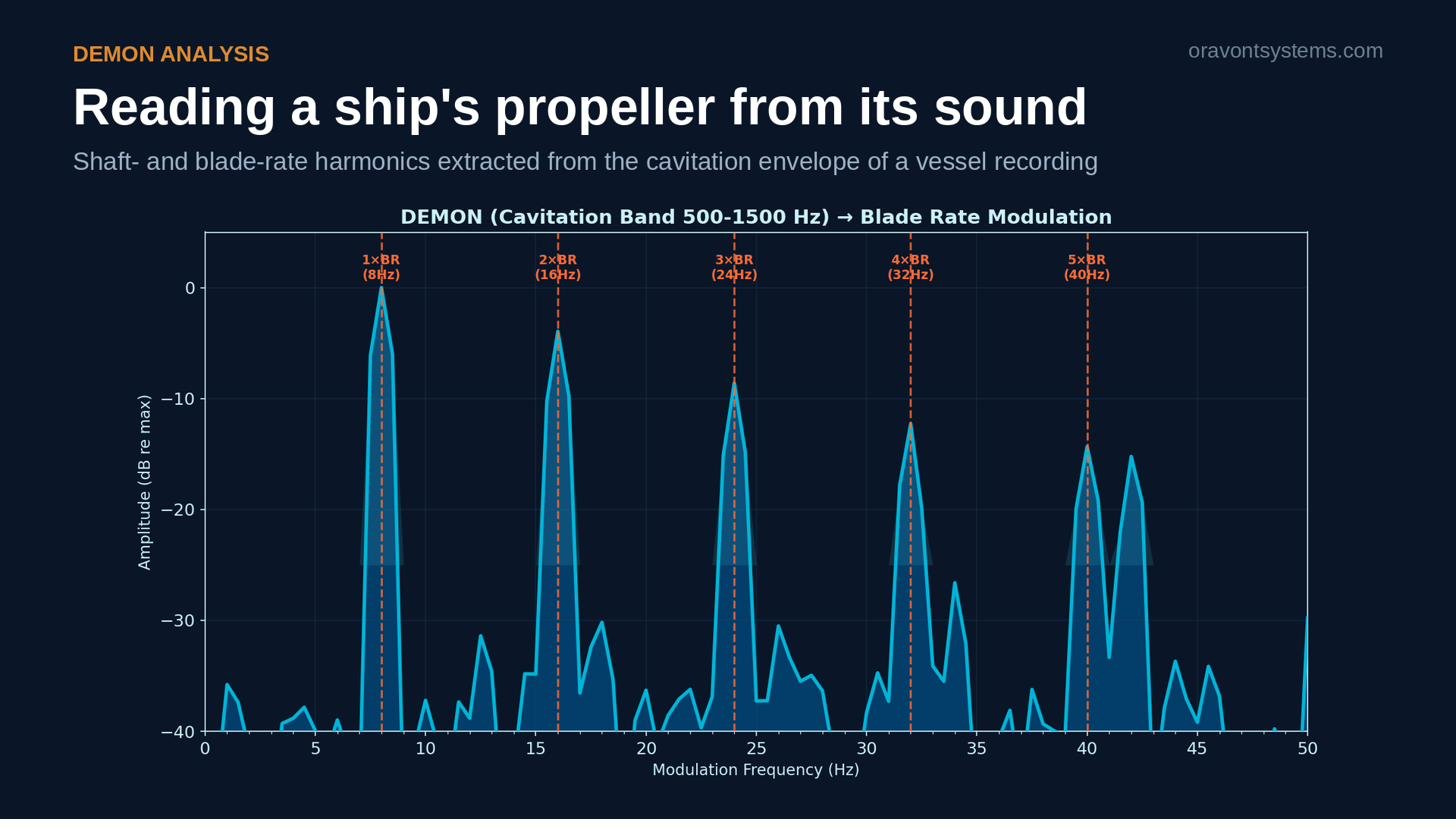
A cavitating propeller is a broadband noise source, but the cavitation is not steady: each blade loads and unloads as it sweeps through the wake, amplitude-modulating the broadband noise at the blade-passage rhythm. The broadband cavitation is the carrier; the propeller kinematics are the modulation. DEMON — Detection of Envelope Modulation on Noise — demodulates the carrier and reads the rhythm, recovering shaft rate and blade rate from noise alone.
The note is a short, practical walk-through: what DEMON extracts, the four-step pipeline (bandpass → Hilbert envelope → AC-coupling → envelope FFT), how to read the output, the band-selection decision most tutorials skip, and a case study where DEMON exposed a defect in a synthetic dataset that conventional spectrograms had hidden. Everything is textbook-level physics applied to open material — deliberately, because the value of DEMON is precisely that it is transparent.