Vessel re-identification
- Open-Set Vessel Re-Identification from Underwater Ship-Radiated Noise with a Raw-Waveform Selective-Kernel Acoustic Neural Network (SKANN) and a Cross-Passage Evaluation Protocol
arXiv:2609.07399 [eess.AS], September 2026 · Read the preprint · DOI · artefacts on Zenodo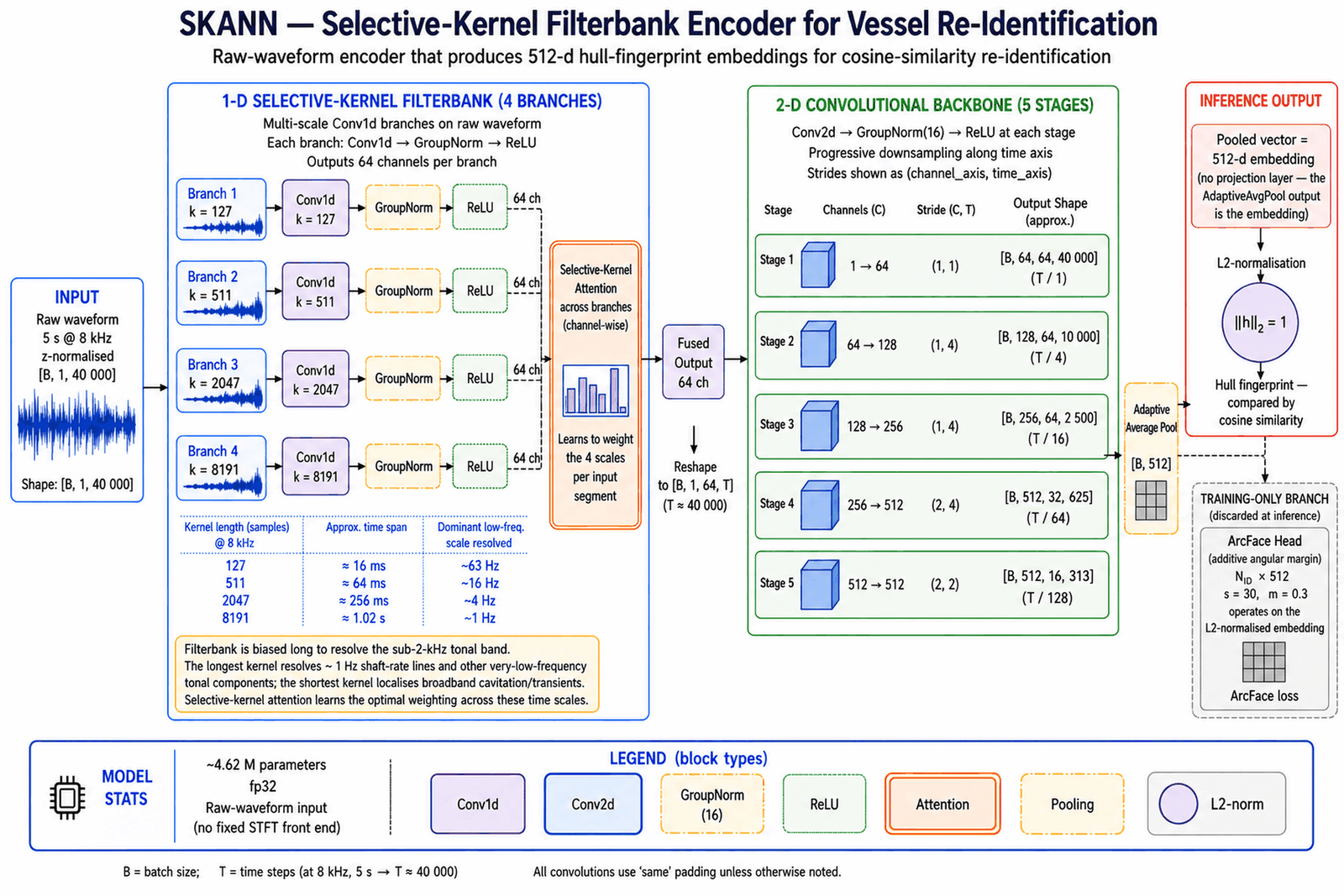
Underwater acoustic target recognition has largely settled on classifying vessels by type, which does not answer whether a monitoring system has heard a particular hull before. This paper formalises that question as open-set, cross-passage re-identification on public hydrophone data, and specifies an evaluation protocol that closes the easiest routes to a flattering score — hull-disjoint splits, galleries and queries drawn from separate passages, and an audio-adjudicated transit-deduplication gate. Transit deduplication alone removes a 16–21 point apparent rank-1 advantage, larger than any difference between the methods compared. The results support analyst triage over a ranked shortlist, not identification.
Patents
A Machine Learning Tool for Ball-Bearing Fault Detection. Ball bearings are fundamental components in rotating machinery, yet their failure remains one of the leading causes of unplanned downtime and catastrophic machinery failures. Detecting faults at an incipient stage — before they escalate into critical issues — is essential for minimising disruptions and extending equipment life.
However, early fault detection is challenging because the vibration signatures of a healthy bearing and one with an emerging defect often appear strikingly similar. Common faults, such as cracks or pits on the outer race, inner race, or rolling elements, may initially generate subtle changes that are difficult to distinguish using conventional diagnostic methods.
Cite as: Tyagi S. Bearing Fault Detection. Official Journal of the Indian Patent Office, p. 20909, 27 May 2016. Patent Application No. 201621003344 A · IPO Grant No. 373427 · Patent document (Figshare)
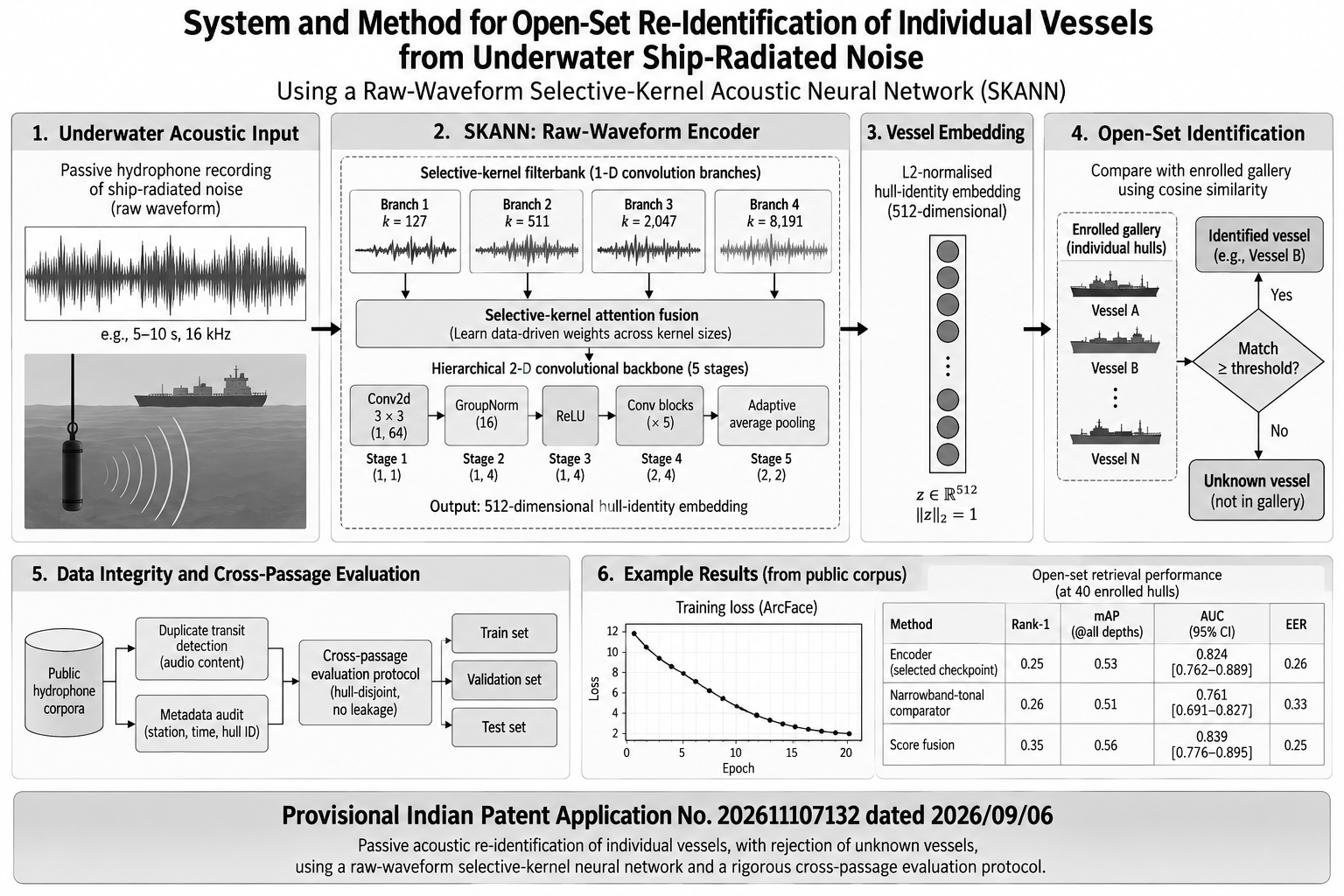
System and method for open-set re-identification of individual vessels from underwater ship-radiated noise using a raw-waveform selective-kernel acoustic neural network, and a cross-passage evaluation protocol therefor.
SKANN is a raw-waveform neural network for open-set re-identification of individual vessels from underwater ship-radiated noise. It builds a hull-identity embedding through multi-resolution selective-kernel processing, then matches a recording against an enrolled gallery by cosine similarity and rejects hulls that are not in it.
The application also covers the leakage-resistant cross-passage evaluation protocol and the transit-level deduplication of source recordings that supports it.
Provisional application, Indian Patent Office. Application No. 202611107132, filed 6 September 2026 · Applicant: Oravont Systems LLP · Inventor: Sunil Tyagi · Complete specification pending.
Books
- The Beginner’s Guide to Quantum Computing: Unlocking the Power of Qubits
Book, 2024.
Book chapters
- A New Frontier in Warfare: Quantum Sensing and Communication
Book chapter, Asian Defence Review, 2024. - Indian AI Military Innovation
Tyagi S, Golani A. In: Cha J, editor. Global AI Military Innovation and Future of Warfare. National Assembly Futures Institute; 2024. p. 109–144. ISBN 979-11-94650-08-9 · Read at NAFI
Journal papers
- Improved envelope detection using PSO for rolling-element bearing fault diagnosis
Journal of Computational Design and Engineering, 2017; 4(4): 305–317 · DOI · Read full paper (open access)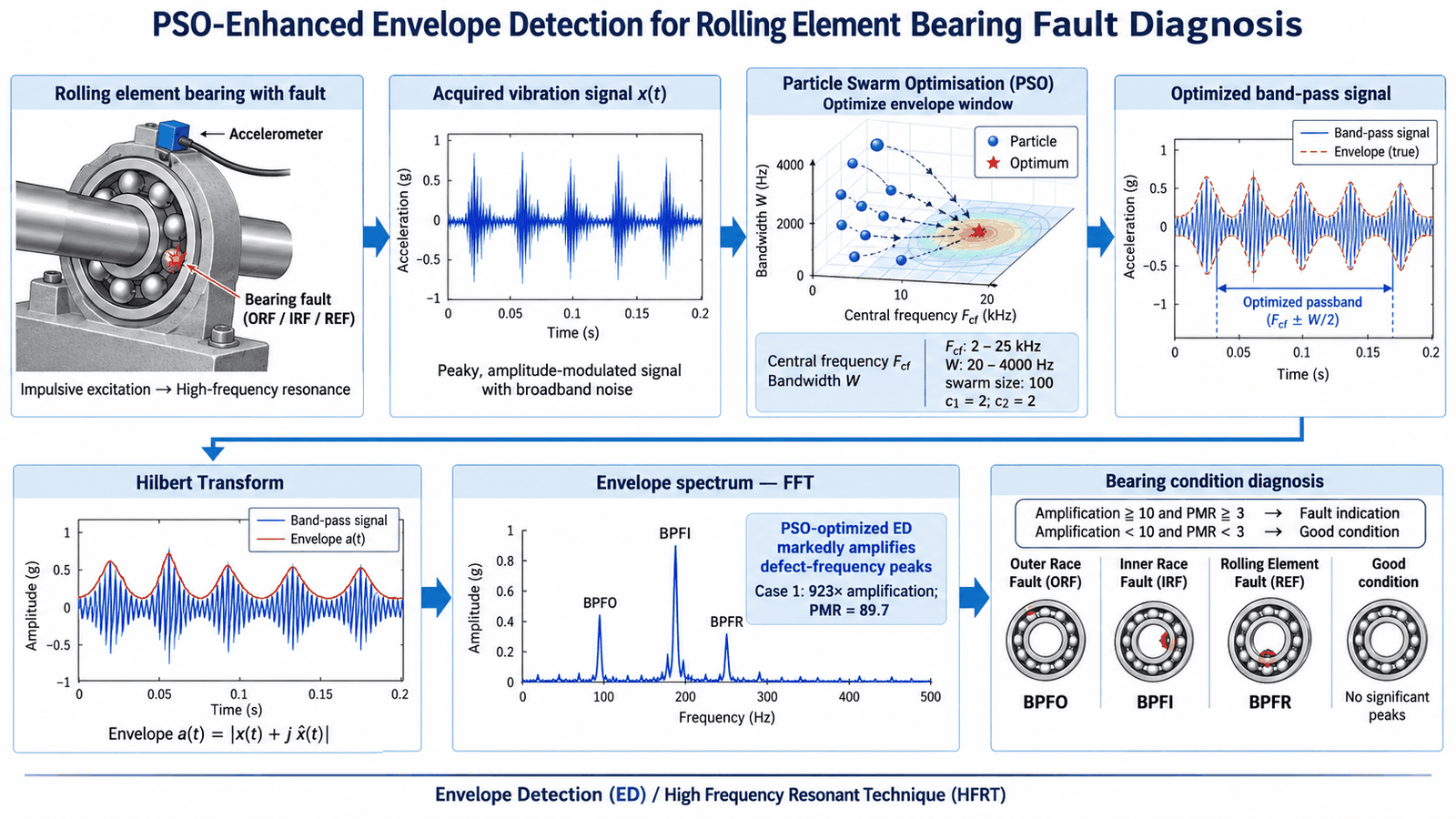
- An SVM–ANN hybrid classifier for gear-fault diagnosis
Tyagi S, Panigrahi SK. Applied Artificial Intelligence (Taylor & Francis), 2017; 31(3): 209–231 · DOI · PDF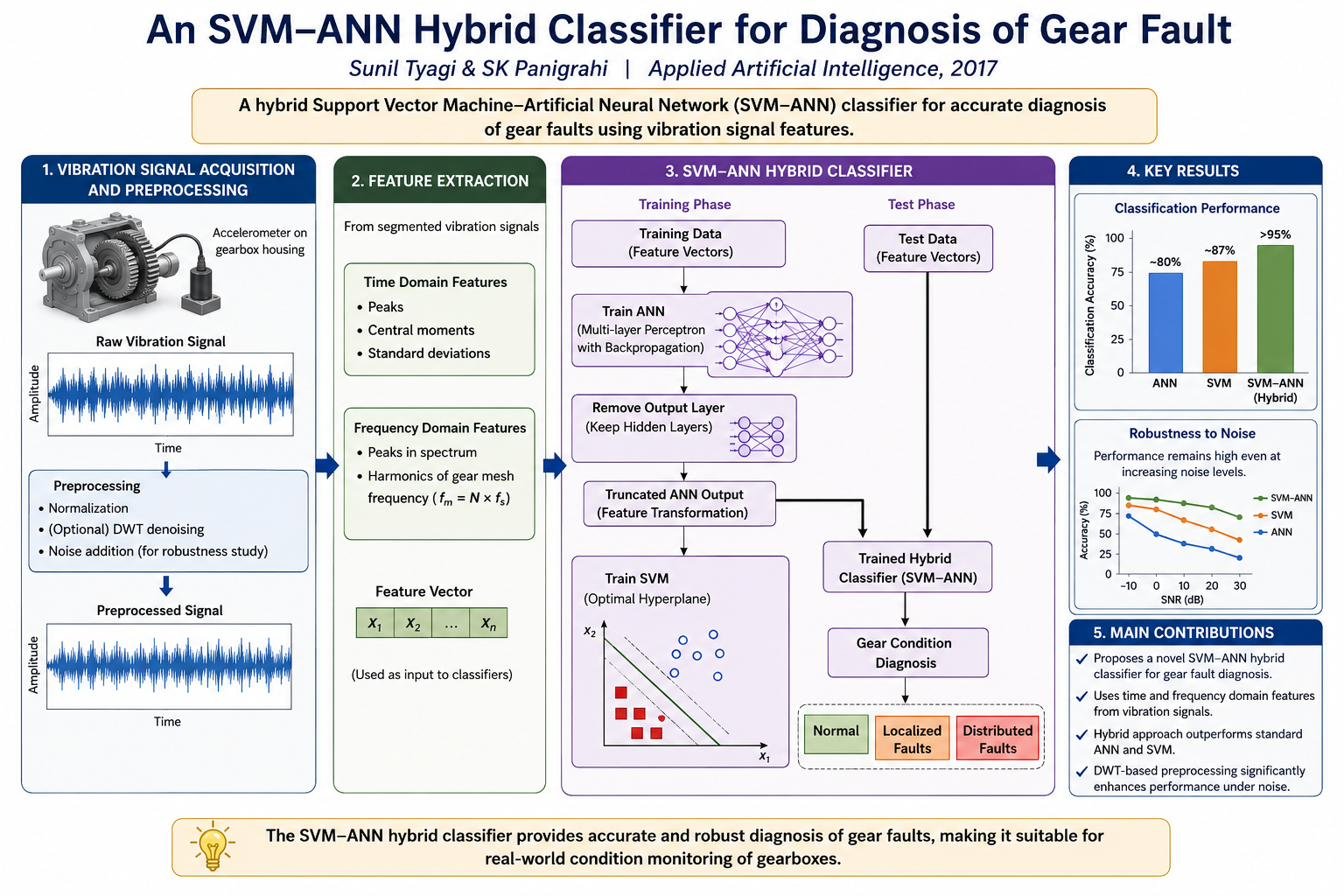
- A hybrid genetic-algorithm and back-propagation classifier for gearbox fault diagnosis
Applied Artificial Intelligence (Taylor & Francis), 2017. - Transient analysis of ball-bearing fault simulation by the finite-element method
Tyagi S, Panigrahi SK. Journal of the Institution of Engineers (India): Series C (Springer), 2014; 95(4): 309–318 · DOI · PDF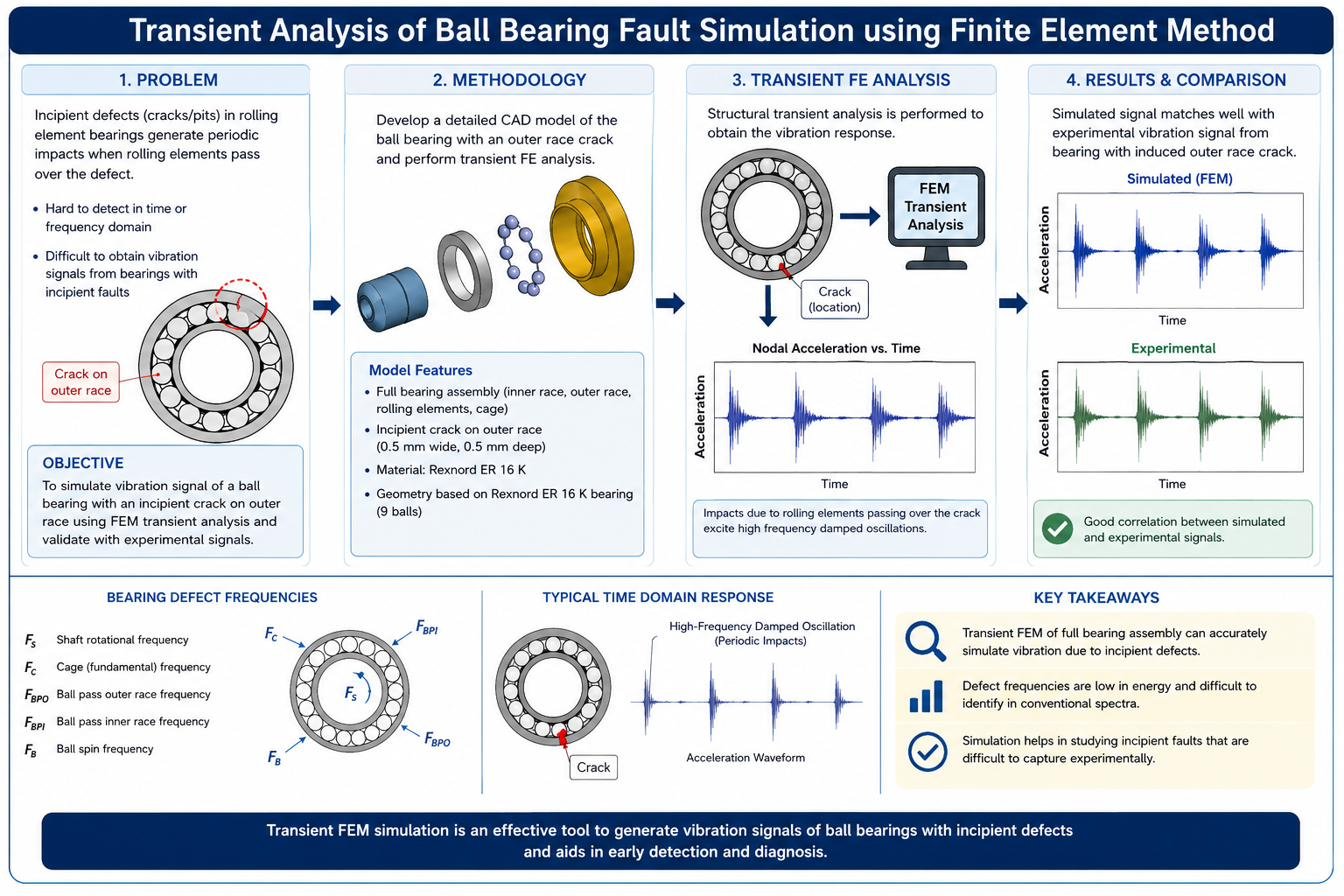
Eight journal publications in total arising from PhD research. Indexed records: ORCID 0000-0001-5897-7955 · Scopus Author ID 57194035292 · Google Scholar.
Working notes
- DEMON Analysis: Reading a Vessel’s Propulsion from Its Own Noise
Working note, 2026 — the physics, the Hilbert envelope, the harmonic comb, and a synthetic-data validation case study. - Building a Physics-Grounded Synthetic Underwater Acoustic Dataset for Self-Supervised Learning
Article, 2026 · open dataset (CC BY 4.0): GitHub repository